

Sampling and diagnosis
What is sampling?
If plants are found to have signs of Panama TR4 during surveillance, the Grower Support (Biosecurity) field team begins the process of assessment, testing and diagnosis by taking a sample.
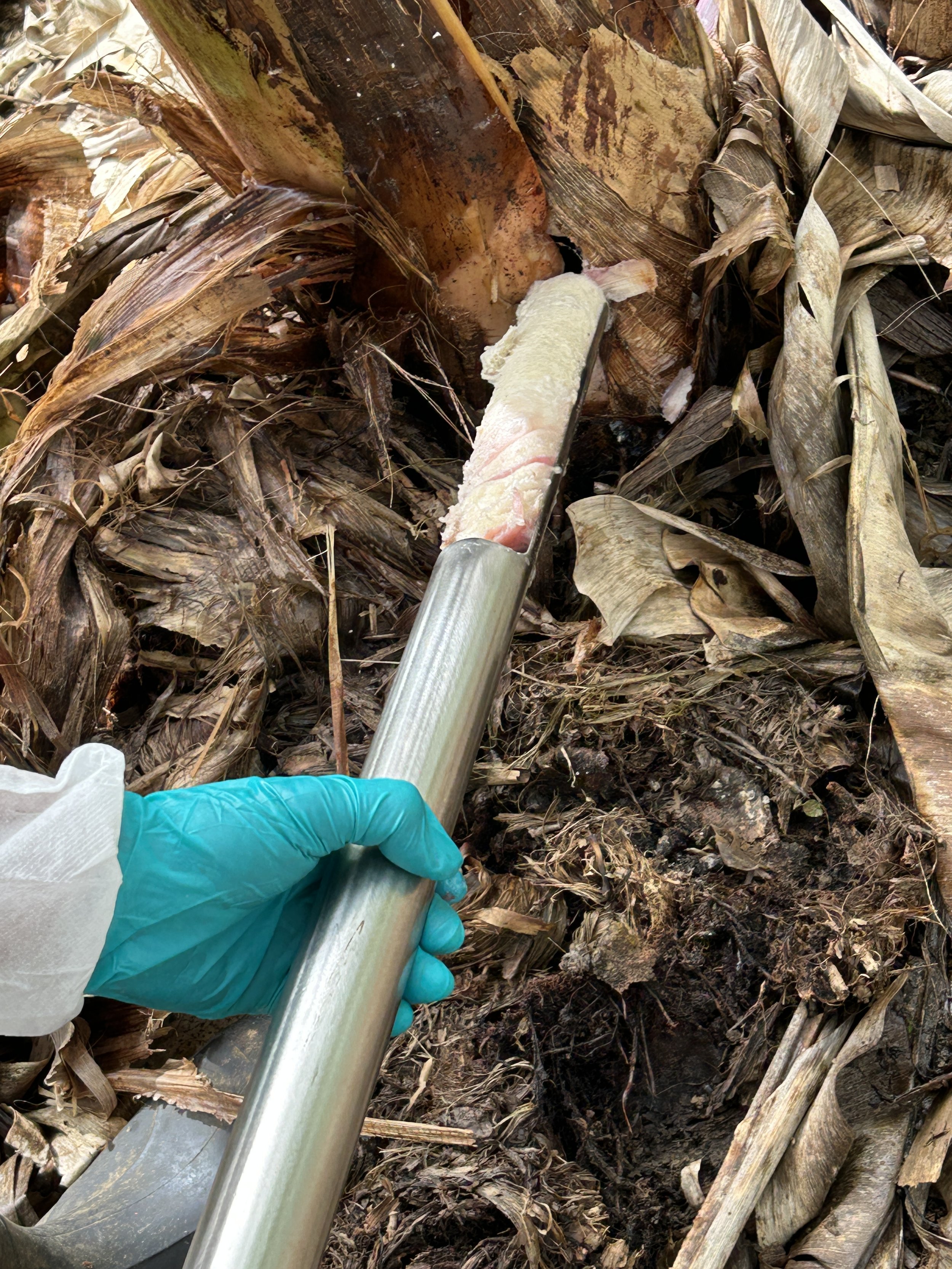
Visual assessment: plants are inspected for external signs of Panama TR4 including leaf yellowing, wilting and stem splitting. If found, the plan is cut to look for internal signs - a yellow, reddish or brown-black discolouration of the stem or corm’s vascular tissue. Photos are taken of intact and cut plants, and the grower will be advised that suspect plants have been found.
Collect and send samples: Samples of plant material are taken from any discoloured tissue that is found in the stem or corm as the plant is systematically examined. The plant or the stump is then marked. Samples are securely packaged, labeled and sent with a secure chain of custody to a specialised Department of Primary Industries laboratory in Brisbane.
Biosecurity Queensland may also take a sample if they receive a public enquiry reporting a suspect plant. They follow the same strict protocols and send to the same laboratory facility in Brisbane.
Timeline and information sharing
Sample taken
Sent to lab
Information shared
PCR test result
VCG test result
After sample collection
After sample collection
Approx. 4 weeks from sample
Approx. 8 weeks from sample
A sample is taken by a member of ABGC’s field crew or by Biosecurity Queensland (public inquiry).
The sample is sent securely to a specialised Queensland Government laboratory.
When a sample is taken, under the Service Level Deed and the Biosecurity Act, both Biosecurity Queensland (as the legislator) and the Australian Banana Growers’ Council (as the delivery partner) are made aware. The information is kept confidential under strict privacy regulations. Read more about this here.
A Polymarease Chain Reaction (PCR) test result will be delivered first. You will be informed of the outcome as soon as it is available.
A Vegetative Compatability Group (VCG) test result provides final confirmation. You will be informed of the outcome as soon as it is available.
Sampling on properties with Panama TR4

Routine sampling is not required on properties where the disease is present.
Instead, growers on infected properties are responsible for destroying any plants that show clear external symptoms of Panama TR4, following the destruction protocol in the Code of Practice.
This decision reflects two things:
Recognition of the proactive way growers are already managing Panama TR4 and making the tough business decisions needed to safeguard their farms.
A smarter use of available resources and diagnostic services.
For any new detections, Biosecurity Queensland will assist with sampling for the first 12 months if required.
While you’re waiting for results
Waiting up to 8 weeks to find out whether Panama TR4 is present on your property can make for an incredibly stressful time.
The Grower Support (Biosecurity) team is here to support you in whatever way they can - from reviewing your current biosecurity measures, to preparing to get your farm back up-and-operating as quickly as possible.
Communicating disease movement with industry
Our commitment to affected growers
The Australian Banana Growers’ Council recognises that receiving confirmation of the presence of Panama TR4 on your property is going to be incredibly stressful. The ABGC will never release your personal information without your explicit consent, but can provide support should you find yourself receiving media or public inquiries through other channels. Regardless of how much support you desire from ABGC, we will keep you updated on the communication plans outlined below.
Our commitment to the banana industry
The industry body – specifically the Grower Support (Biosecurity) program - has a duty to inform the rest of industry about the movement of this disease. Any information shared about new detections will not identify the grower/s, unless explicitly agreed. In the interests of industry preparedness, these communications will occur regardless of whether the detection was made via ABGC surveillance or public inquiry through Biosecurity Queensland.
New detections in the Tully Valley
Industry will be notified of new detections in the Tully Valley via inclusion in e-bulletins.
Notification will take place once all required testing (PCR and VCG) is complete. This process can take up to 8 weeks from sample.
Unless otherwise decided in consultation with the affected grower, the grower will not be identified. ABGC will note that the detection is in the Tully Valley.
New detections outside the Tully Valley
Industry will be notified of a new detection outside the Tully Valley via SMS, e-bulletin, website and media release.
Notification will take place after at least the PCR test has returned a positive result. This process can take 4 weeks from sample.
Unless otherwise decided in consultation with the affected grower, the grower will not be identified.
Neighbouring properties will be informed directly per the relevant policy.
Public communication will inform the broader industry of enough detail relating to location to make informed decisions about their own farms/businesses, without jeopardising privacy or response activities.
ABGC will facilitate additional grower communications as required, including meetings (online and in-person).
This website will be kept up-to-date with statistics and relevant information.